





Privacy in 2026 demands more than promises. When you connect to the internet through a Virtual Private Network, you're trusting that provider with every website you visit, every file you download, and every message you send. A no log VPN represents a fundamental commitment: your provider will not record, store, or share your online activity. This pledge transforms your VPN from a security tool into a true privacy shield, but understanding what "no logs" actually means requires examining the technical architecture, legal frameworks, and verification methods that separate genuine privacy protection from marketing claims.
What No Logs Actually Means in Practice
The term "no log VPN" describes a service that does not collect or retain records of user activity, connection timestamps, IP addresses, or browsing destinations. This policy extends beyond simple marketing language to encompass specific technical decisions about data collection, retention, and processing.
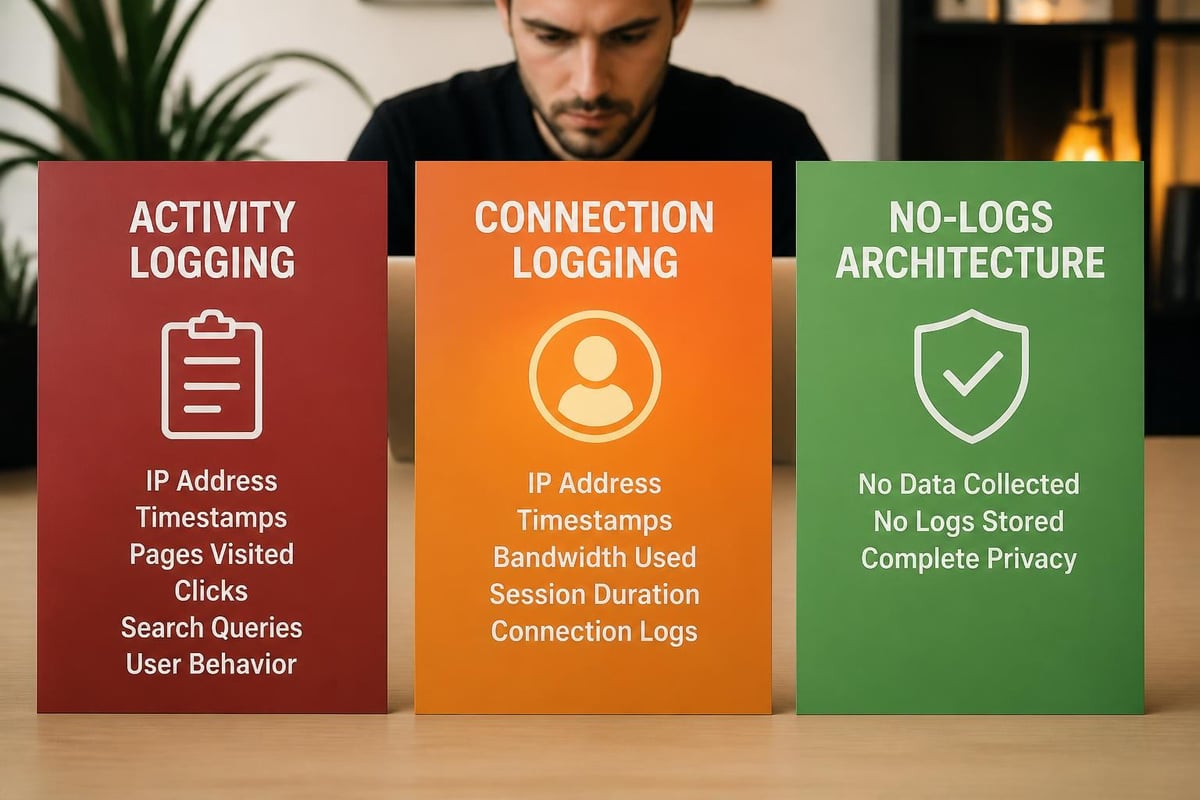
Connection Logs vs. Activity Logs
VPN providers distinguish between different types of data collection, and understanding these categories helps evaluate privacy claims:
| Log Type | What It Contains | Privacy Impact |
|---|---|---|
| Activity Logs | Websites visited, files downloaded, DNS queries | Complete browsing history exposed |
| Connection Logs | Timestamps, session duration, bandwidth used | Can correlate user identity with timeframes |
| No Logs | Only payment/account data, no usage records | Maximum privacy protection |
Activity logs represent the most invasive form of data collection. These records capture every domain you visit, every search query you make, and every service you access while connected. When a provider maintains activity logs, they possess a complete digital record of your online behavior.
Connection logs track metadata about your VPN sessions without recording destinations. While less invasive than activity logs, connection data can still compromise privacy when combined with other information sources. A timestamp showing you connected from a specific location at 3:47 PM can be cross-referenced with other data to identify you.
A true no log VPN eliminates both categories, maintaining only the minimum information required to operate the service: your account credentials and payment information. The Electronic Frontier Foundation's VPN guide explains how to evaluate these privacy claims and what questions to ask providers about their data practices.
Technical Architecture Behind Zero-Knowledge Systems
Implementing a genuine no log VPN requires specific technical choices that prevent data collection at the infrastructure level. Providers committed to privacy design their networks to make logging technically impossible or meaningless rather than relying solely on policy promises.
RAM-only servers represent one critical architectural decision. Traditional hard disk servers retain data even after deletion, creating forensic recovery risks. By running all servers entirely from volatile memory (RAM), providers ensure that every restart completely erases all operational data. Power loss or forced shutdown results in total data destruction.
Diskless infrastructure extends this concept across the entire network. When servers boot from read-only images and store nothing locally, there's simply no persistent storage where logs could accumulate. This architecture makes compliance with logging demands technically impossible, even under legal pressure.
Separation of identity and activity constitutes another fundamental design principle. By processing payments through systems completely isolated from connection infrastructure, providers prevent correlation between "who paid" and "who connected." Anonymous payment options like cryptocurrency strengthen this separation further.
ZioFree's security protocols demonstrate how advanced encryption and infrastructure choices work together to protect privacy from technical, legal, and operational threats.
Verifying No-Logs Claims Through Independent Audits
Marketing materials frequently claim "strict no-logs policies," but verification requires external validation. Independent security audits have become the industry standard for confirming that technical implementation matches privacy promises.
Understanding Third-Party Audit Standards
Professional security firms conduct no-logs audits using established frameworks that examine code, infrastructure, and operational procedures. The IAASB's ISAE 3000 standard provides the most rigorous framework for non-financial assurance engagements, including privacy policy verification.
Legitimate audits involve:
- Source code review examining logging functions and data handling
- Infrastructure inspection validating server configurations and storage systems
- Operational assessment testing incident response and data request procedures
- Public reporting publishing findings with specific technical details
Generic "trust us" statements or internal audits lack the credibility of independent examination by recognized security firms. Look for audit reports that name the auditing firm, specify the methodology used, and provide detailed findings rather than vague assurances.
Transparency Reports and Warrant Canaries
Beyond formal audits, transparency reports demonstrate ongoing commitment to privacy protection. These public documents detail the number and nature of data requests received from governments and law enforcement, along with how the provider responded.
Effective transparency reports include:
- Total number of requests received per quarter
- Jurisdiction of each requesting authority
- Type of data requested (user identity, connection logs, activity records)
- Provider response (data provided, request denied, no data available)
- Legal basis for each request (warrant, subpoena, national security letter)
The most revealing aspect of no log VPN transparency reports often appears in the "data provided" column. When providers consistently report "no data available" in response to activity requests, their technical architecture successfully prevents collection regardless of legal pressure.

Jurisdictional Considerations for Privacy Protection
Where your VPN provider operates fundamentally affects the strength of their no-logs commitment. Legal frameworks vary dramatically across countries, with some jurisdictions mandating data retention while others protect privacy through constitutional provisions.
Privacy-Friendly vs. Mandatory Retention Jurisdictions
Different countries impose vastly different obligations on VPN providers, regardless of company privacy policies:
| Jurisdiction Type | Examples | Data Retention Requirements |
|---|---|---|
| Privacy-Protective | Switzerland, Iceland, British Virgin Islands | No mandatory retention, strong privacy laws |
| Five Eyes | US, UK, Canada, Australia, New Zealand | Intelligence sharing, potential NSL requirements |
| Mandatory Retention | EU (varies), Russia, China | Required logging periods from 6-24 months |
Providers operating under privacy-protective jurisdictions enjoy legal frameworks that support genuine no-logs operations. Switzerland, for example, does not require telecommunications providers to retain user activity data, and constitutional privacy protections limit government data requests.
Conversely, CISA's guidance on network access security highlights how regulatory requirements in certain jurisdictions can undermine privacy claims by mandating retention periods that contradict "no logs" promises.
The Five Eyes Intelligence Alliance
The Five Eyes alliance represents a particularly significant concern for privacy-focused users. Member nations share intelligence data extensively, meaning a request from any member can potentially access data collected by any other member.
When a VPN provider operates headquarters, servers, or staff within Five Eyes countries, they face potential National Security Letter (NSL) demands that prohibit disclosure. The provider may be legally forbidden from even acknowledging they received a data request, making transparency reports incomplete by design.
Understanding how different VPN options compare helps you evaluate jurisdictional risks alongside technical features when selecting privacy-focused services.
Common Limitations of No-Logs Promises
Even genuine no log VPN services cannot prevent all privacy risks. Understanding the boundaries of what your VPN protects helps you maintain realistic expectations and implement complementary security measures.
Technical Leaks Beyond VPN Control
WebRTC leaks represent one persistent challenge. Web Real-Time Communication protocols can expose your actual IP address directly from your browser, completely bypassing VPN protection. RFC 8828 details the technical mechanisms through which WebRTC handles IP addresses and why these features can compromise VPN anonymity.
DNS leaks occur when domain name lookups bypass the VPN tunnel, sending queries directly to your ISP's DNS servers. Even if your browsing traffic travels through the encrypted VPN connection, DNS requests reveal every website you visit.
IPv6 leaks happen when your device uses IPv6 connectivity while your VPN only routes IPv4 traffic. The unprotected IPv6 connection can expose your activity and identity outside the VPN tunnel.
Mitigating these risks requires:
- Disabling WebRTC in browser settings or using extensions that block it
- Verifying your VPN uses its own DNS servers and blocks external queries
- Disabling IPv6 entirely or confirming your VPN routes both IPv4 and IPv6
- Testing for leaks regularly using online detection tools
The Payment and Account Information Exception
No log VPN providers must collect some data to operate a functional business. Account information represents the primary exception to zero-data-collection policies.
Providers typically maintain:
- Email address or username for account access
- Payment information or transaction records
- Account creation timestamp and subscription status
- Support ticket history and communications
This data creates a potential privacy risk if correlated with connection patterns. Sophisticated adversaries with access to payment records and timestamps from external sources could potentially identify users despite the absence of activity logs.
Mitigation strategies include:
- Using anonymous email addresses created specifically for VPN registration
- Paying with privacy-focused methods like cryptocurrency or prepaid cards
- Avoiding personally identifiable information in usernames or support requests
- Creating accounts over public Wi-Fi or existing VPN connections
Research on VPN privacy expectations reveals significant gaps between user understanding and actual privacy protection, particularly around payment data retention and correlation risks.
Evaluating Provider Claims and Marketing Language
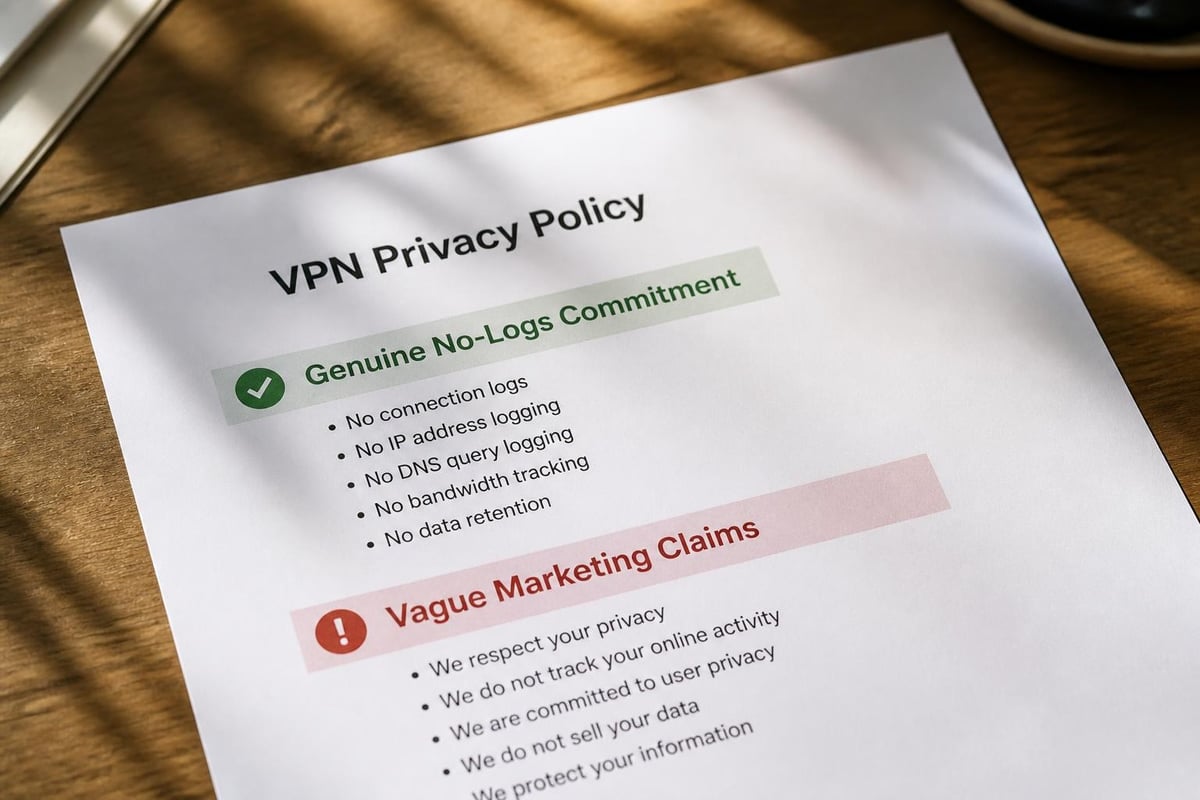
The VPN industry uses "no logs" terminology inconsistently, with some providers applying the term broadly while maintaining extensive data collection. Learning to distinguish genuine commitments from marketing exaggeration protects you from false privacy assurances.
Red Flags in Privacy Policies
Careful privacy policy review reveals whether a no log VPN actually implements zero-knowledge architecture:
Concerning language includes:
- "We may log connection data for troubleshooting purposes"
- "Aggregate anonymized data for service improvement"
- "Information shared with trusted partners or affiliates"
- "We comply with all legal data requests"
- Vague timeframes like "temporary logging" without specific deletion schedules
Positive indicators include:
- Specific enumeration of what data is NOT collected
- Technical explanations of RAM-only or diskless infrastructure
- Named independent audits with public reports
- Detailed transparency reports showing "no data available" responses
- Jurisdiction chosen specifically for privacy protections
Comparative methodology from VPN review sites provides frameworks for systematically evaluating these claims and identifying inconsistencies between marketing and policy documents.
Academic Research on Logging Practices
Empirical research increasingly examines the gap between stated policies and actual practices. Studies analyzing log disclosure and privacy alignment demonstrate that provider behavior under legal pressure sometimes contradicts published no-logs claims.
Academic investigations use technical analysis, legal document review, and controlled testing to verify whether providers actually implement their stated privacy protections. These independent assessments often reveal discrepancies that marketing materials and privacy policies obscure.
When evaluating any no log VPN, prioritize evidence over promises:
- Independent technical audits from recognized security firms
- Transparency reports documenting actual legal requests and responses
- Public track record when providers face government data demands
- Academic or journalistic investigations into actual practices
- Community scrutiny from privacy advocates and technical experts
Beyond No Logs: Comprehensive Privacy Protection
A genuine no log VPN forms the foundation of online privacy, but comprehensive protection requires additional layers. Understanding how your VPN fits within broader security practices maximizes the value of your privacy investment.
Encryption Standards and Protocol Security
The no-logs commitment protects you from your VPN provider, but strong encryption protects you from everyone else monitoring network traffic. Modern secure VPN services implement current cryptographic standards that resist known attacks.
Essential encryption features:
- AES-256 encryption for data confidentiality
- Perfect forward secrecy preventing retroactive decryption
- Secure protocols like WireGuard or OpenVPN with modern cipher suites
- Protection against downgrade attacks and protocol vulnerabilities
Protocol considerations detailed in RFC 8280 examine how technical choices affect privacy properties and what protocol-level features support or undermine anonymity guarantees.
Kill Switch and Leak Protection
Technical failures pose privacy risks even when your no log VPN operates correctly. Network interruptions, reconnection delays, or software crashes can briefly expose your real IP address and unencrypted traffic.
Essential protective features include:
- Network kill switch blocking all internet access when VPN disconnects
- Application-specific kill switches protecting individual programs
- Automatic reconnection with zero-data-leak guarantees
- Split tunneling with clear understanding of protected vs. unprotected traffic
Private internet security practices extend beyond VPN selection to encompass device configuration, browser settings, and operational security habits that complement technical privacy tools.
Multi-Hop and Onion Routing Enhancements
Single-hop VPN connections route traffic through one server before reaching its destination. Multi-hop configurations add additional privacy layers by routing through multiple servers in different jurisdictions.
Benefits of multi-hop routing:
- No single server knows both your identity and your destination
- Jurisdictional diversity protects against regional legal demands
- Defense in depth if any single server is compromised
- Enhanced protection against traffic correlation attacks
However, multi-hop connections sacrifice speed for privacy. The additional routing introduces latency that may not suit time-sensitive applications like video calls or gaming.
Real-World Implications for Different User Profiles
Privacy needs vary dramatically based on your threat model. Understanding what you're protecting against helps you evaluate whether a no log VPN provides sufficient protection or whether you need additional security measures.
Journalists and Activists
Professional communicators working in hostile environments face sophisticated adversaries with substantial resources. A no log VPN protects source communications and research activities, but represents only one component of comprehensive operational security.
Additional considerations include:
- Physical device security and full-disk encryption
- Secure communication platforms with end-to-end encryption
- Operational procedures preventing correlation through timing or behavior
- Understanding that no technical tool provides absolute protection
Privacy-Conscious Consumers
Most users simply want to prevent ISPs, advertisers, and data brokers from tracking online behavior. For this threat model, a verified no log VPN provides excellent protection when combined with privacy-focused browsers and blocking tracking cookies.
Understanding the real difference between VPN and incognito mode clarifies how these tools complement each other rather than providing redundant protection.
Remote Workers and Businesses
Organizations using VPNs for secure remote access face different requirements than individual privacy users. CISA's guide to securing remote access explains configuration challenges and data exposure risks that affect how businesses should evaluate no-logs commitments.
Commercial VPN use often requires some logging for troubleshooting, capacity planning, and incident response. Businesses must balance operational requirements against privacy goals, potentially accepting limited connection logging while eliminating activity tracking.
Emerging Threats and Future Privacy Challenges
Privacy protection evolves constantly as new technologies and threats emerge. Understanding developing challenges helps you anticipate how your no log VPN must adapt to maintain effective protection in coming years.
AI and Machine Learning Correlation
Advanced traffic analysis increasingly uses machine learning to identify users through behavioral patterns even without direct logging. Timing analysis, traffic volume patterns, and website fingerprinting can potentially correlate encrypted VPN traffic with known user behavior.
No log VPN providers address these emerging threats through:
- Traffic obfuscation making VPN connections appear as regular HTTPS
- Timing randomization preventing correlation through connection patterns
- Cover traffic injection adding noise that obscures actual usage
- Protocol improvements that resist fingerprinting techniques
Quantum Computing and Encryption
Future quantum computers threaten current encryption standards by potentially breaking the mathematical problems that secure today's cryptography. While practical quantum attacks remain years away, forward-thinking providers are already implementing post-quantum cryptographic algorithms.
A no log VPN becomes meaningless if adversaries can decrypt your traffic retroactively. Providers committed to long-term privacy implement:
- Post-quantum key exchange algorithms resistant to quantum attacks
- Regular cryptographic updates as standards evolve
- Perfect forward secrecy ensuring past sessions remain secure even if future keys are compromised
Staying informed about VPN technology developments helps you understand when your provider implements meaningful security improvements versus marketing-driven feature announcements.
Regulatory Pressure and Backdoor Demands
Governments worldwide increasingly pressure technology providers to implement surveillance capabilities or provide exceptional access to encrypted communications. No log VPN services operating internationally face complex legal environments where compliance in one jurisdiction may compromise privacy globally.
Providers resist these pressures through:
- Jurisdictional selection prioritizing privacy-protective legal frameworks
- Technical architecture making backdoors architecturally impossible
- Transparency about government requests and legal challenges
- Public advocacy supporting privacy rights and opposing surveillance expansion
Privacy in 2026 requires more than trust-it demands verification, technical implementation, and ongoing vigilance. A genuine no log VPN eliminates the single greatest privacy risk in VPN usage: your provider itself becoming a surveillance point through data retention and sharing. By understanding what no-logs actually means, how to verify provider claims, and what complementary protections strengthen your privacy posture, you transform your VPN from a simple security tool into comprehensive protection against surveillance, tracking, and data collection. ZioFree implements verified no-logs architecture backed by strong encryption, RAM-only servers, and jurisdictional protections that ensure your online activity remains truly private-with specialized defense against sophisticated hacking attempts and surveillance operations.