




A VPN inside China can work in 2026, but only if you pick a service built to get past the Great Firewall and install it before you arrive. Most mainstream VPNs are blocked on a regular basis, so reliability depends on obfuscation, server choice and preparation rather than brand recognition alone.
The reasons to try are practical. Freedom House reports that thousands of websites are blocked in China, including the New York Times, BBC, YouTube, X and Facebook. The UK Home Office's January 2026 country note goes further, stating that the Great Firewall blocks over 200,000 websites, citing a separate estimate of over 100,000 blocked websites as of February 2024. For a privacy-conscious user, that censorship comes paired with local network monitoring, which makes encrypted traffic the baseline rather than an extra.
This guide covers how the blocking works, which services are reported to work, how to prepare, and what to do when a connection fails.
How the Great Firewall blocks VPN traffic
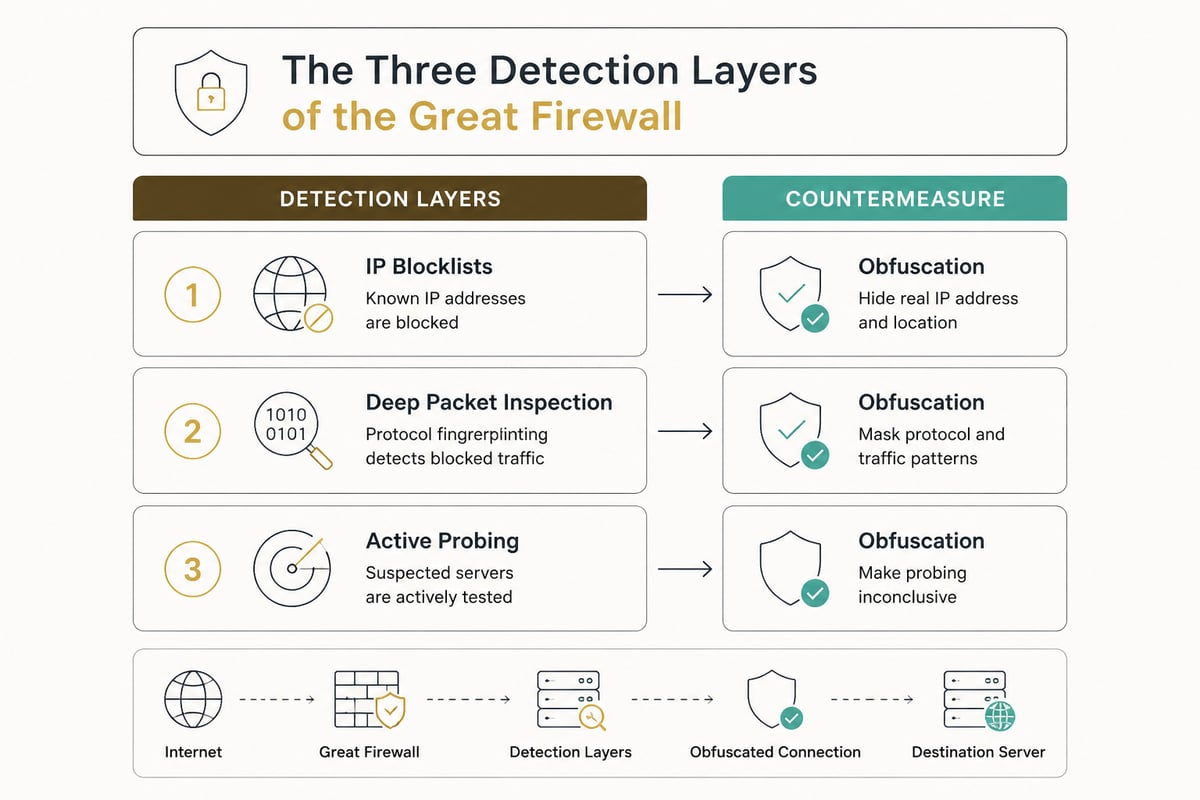
The Great Firewall identifies and throttles VPN traffic through deep packet inspection, IP blocklists and active probing of suspected servers. Standard protocols such as plain OpenVPN and IKEv2 produce recognizable traffic patterns, which is why they often fail within seconds of connecting.
Three layers matter most:
- IP blocking: Known VPN server addresses are added to blocklists, so popular servers fail first.
- Protocol fingerprinting: Traffic shapes that look like a VPN are slowed or reset.
- Active probing: The firewall contacts suspected servers to confirm what they are, then blocks them.
Enforcement is not static. Freedom House's Freedom on the Net 2025 report notes that authorities in Henan implemented an additional website-blocking system alongside the national firewall, and its country profile records an hour-long connectivity disruption in August 2025, likely caused by a Great Firewall misconfiguration. Conditions shift by region, by carrier and by season, so a service that worked last month may need a different protocol this month.
Is it legal to use a VPN inside China?
Using an unlicensed VPN inside China sits in a legal gray area: the government approves only licensed services, and offshore commercial VPNs are not authorized. Enforcement has historically targeted sellers and operators of unlicensed services more than ordinary visitors, though penalties for individuals have been reported in some cases.
If you are asking what happens if you are caught, the realistic outcomes reported publicly range from no action to a warning or a fine, and the risk varies by region and circumstance. Treat this as general background, not legal advice, and check current guidance from your own government's travel advisory before departure. Do not sell or share VPN access with others while in the country.
What to look for in a VPN that works in China
A VPN that works in China needs obfuscated protocols, a record of server rotation, and apps you can install before you travel. Check these points before paying:
- Obfuscation or stealth protocol: The service should disguise VPN traffic as ordinary HTTPS or use a non-standard protocol.
- Multiple protocol options: When one is blocked, switching to another often restores access.
- Pre-departure downloads: Western app stores and many VPN websites are blocked inside the country, so installers must be on your device first.
- A strict no-logs policy and strong encryption: A tunnel that leaks identifying data defeats its own purpose.
- Nearby servers: Hong Kong, Japan, Singapore and South Korea typically give lower latency than distant regions.
- Support you can reach: Email or live chat that works through the firewall helps when a protocol stops connecting.
For a deeper look at server and protocol selection, see this guide to the best VPN for China.
1. TotalVPN
TotalVPN is a service reported to have produced positive results in at least one recent China test. Its specifications and pricing were not available in the research used for this article. Its public specifications were not available in the research used for this article, so verify its current protocols and server list before purchase.
- Specs: Not shown in the available search results.
- Price: Not shown in the available search results.
- Use case: Readers who want a second service that has shown positive results in a recent China test, and who should confirm access before relying on it.
- Verdict: Worth considering as a backup option, with current performance confirmed before you rely on it.
2. Hotspot Shield
Hotspot Shield appears among the VPNs reported as working in a 2026 comparison. As with any service in this market, results can differ by city and carrier, so one report is a starting point rather than a guarantee.
- Specs: Not shown in the available search results.
- Price: Not shown in the available search results.
- Use case: Readers looking for an additional option that has been reported working in a 2026 comparison, to keep as a fallback alongside a primary service.
- Verdict: A reasonable second install, but test it on arrival before depending on it for sensitive work.
3. VyprVPN
VyprVPN is listed among services reported as working in a 2026 comparison. Its specifications and pricing were not available in the research used for this article.
- Specs: Not shown in the available search results.
- Price: Not shown in the available search results.
- Use case: Readers who want to consider a mixed-results option and verify current access before relying on it.
- Verdict: Acceptable as one of several installed apps, but not a service to trust as your only tunnel.
4. ZioFree VPN 12 Months
ZioFree VPN 12 Months is a one-year subscription priced at about $3.60 per month. It includes unlimited bandwidth and access to all servers, and ZioFree describes its service as offering strong encryption and a strict no-logs policy.
- Use case: Privacy-conscious users who want strong encryption and a longer plan at a lower monthly rate. Split tunnelling lets you send only chosen apps through the VPN. ZioFree does not publish China-specific performance guarantees here, so confirm current access on the ZioFree site and install before you leave.
- Verdict: A strong privacy and cost profile; verify China connectivity yourself before relying on it.
5. ZioFree VPN Monthly
ZioFree VPN Monthly is a month-to-month plan priced at about $5.83 per month, with unlimited bandwidth and access to all servers.
- Use case: A short trip where you want to test the service without a long commitment. You can view the plan here and cancel after your travel dates.
- Verdict: The sensible choice for a single visit, at a higher per-month cost than the 12-month plan.
Comparison of the services above
| Service | Reported China status | Price (approx., as of November 2026) | Best for |
|---|---|---|---|
| TotalVPN | Positive in at least one recent China test | Not listed | A backup option |
| Hotspot Shield | Reported working in a 2026 comparison | Not listed | An additional fallback |
| VyprVPN | Mixed results | Not listed | Testing before relying on it |
| ZioFree VPN 12 Months | Verify before travel | About $3.60 per month | Longer-term privacy use |
| ZioFree VPN Monthly | Verify before travel | About $5.83 per month | A single short trip |
What about astrill and other specialist services?
Astrill is a specialist service that markets itself around restrictive networks. Per Astrill's pricing page, it lists servers in 50+ countries, unlimited bandwidth and server switches, and the OpenVPN, StealthVPN, OpenWeb and WireGuard protocols. Specialists like this tend to cost more than mainstream plans, so the trade-off is price against a protocol set designed for blocked regions.

How to set up a VPN inside China before you travel
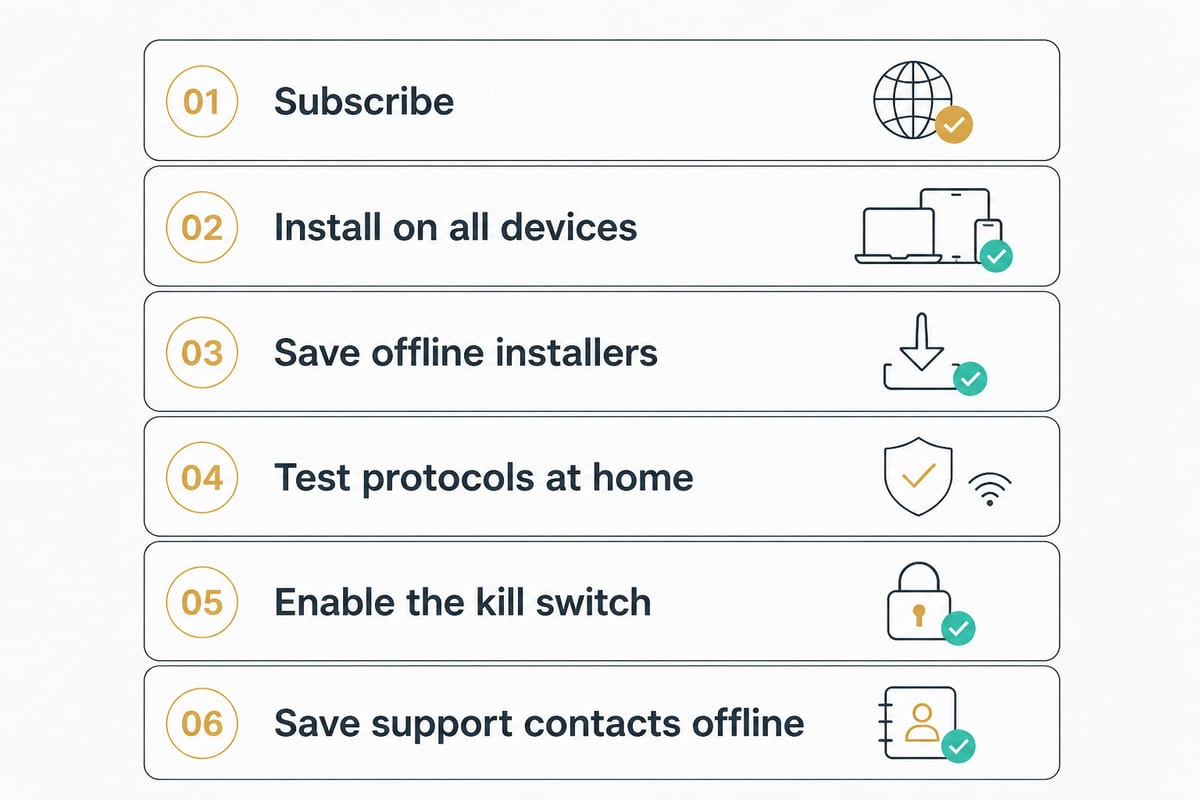
Set up your VPN before departure, because most VPN websites and app stores are blocked once you land. A short checklist:
- Subscribe and install the app on every device you will carry, including a laptop and phone.
- Download an offline copy of the installer or configuration files as a backup.
- Test each protocol on your home network and note which ones you may need to switch between.
- Enable the kill switch so no traffic leaks if the tunnel drops.
- Set up split tunnelling for any domestic apps that work better without a VPN.
- Keep support contact details saved offline.
If you travel with a router or share a connection across devices, a travel VPN router can protect every device behind it with one configuration.
What to do if your VPN inside China stops working
When a VPN inside China stops connecting, switch protocol first, then server, then port. Work through these steps in order:
- Change the protocol: Move from the default to a stealth or obfuscated option, or to WireGuard or OpenVPN over TCP.
- Change the server: Try a nearby location such as Hong Kong, Japan or Singapore rather than a distant one.
- Change the port: Port 443 often blends with normal web traffic. See this explanation of VPN protocols and ports.
- Switch networks: Mobile data and hotel Wi-Fi are filtered differently, so a failure on one may work on the other.
- Wait and retry: Blocking often tightens around major political events and then eases.
- Contact support: Providers frequently publish updated server lists during blocking waves.
A kill switch matters here, since a dropped tunnel on an unprotected network exposes your traffic.
Streaming and everyday use through a China VPN
Streaming services are blocked or restricted inside China, and a VPN that connects does not always unlock them. Speeds also drop because traffic crosses the firewall. If streaming is a priority, read this overview of VPN use for Netflix in China and set realistic expectations for throughput.
Use split tunnelling so domestic apps, banking and payment tools run outside the tunnel, which avoids slowdowns and flagged logins. Keep sensitive tasks, such as email and messaging, inside the encrypted tunnel.
Free VPNs and low-cost options
Free VPNs rarely work inside China, and they carry privacy risks, since their business model often depends on data. If cost is the concern, the cheapest workable route is a longer paid plan rather than a free service. Cheaper plans still need to disclose a clear no-logs policy and modern encryption.
FAQ
Can I just use a VPN in China?
You can attempt to, but it only works if the service is obfuscated and installed before you arrive. Without those, most standard VPN apps fail to connect or drop quickly.
What is the cheapest VPN for China?
Longer plans generally cost less per month, so a 12-month subscription is usually the lowest-cost route. Confirm that any low-priced plan includes obfuscation and a no-logs policy before you buy.
What happens if I get caught with a VPN in China?
Publicly reported outcomes range from no action to a warning or a fine, with enforcement aimed mainly at sellers and operators of unlicensed services. Check your government's current travel advisory, since rules and enforcement can change.
Before your next trip, install your VPN on every device and test two different protocols on your home network so you know your fallback options. If you want a service with AES-256 encryption, a kill switch, split tunnelling and a strict no-logs policy, consider the ZioFree VPN 12 Months plan, which includes unlimited bandwidth and access to all servers. You can Get Started Now with ZioFree to secure your connection before you travel.