



Understanding how VPN network work has become essential knowledge for anyone concerned about online privacy and security in 2026. Virtual Private Networks create encrypted connections that shield your internet activity from prying eyes, but the underlying technology involves multiple sophisticated processes working in harmony. This comprehensive guide breaks down each component of VPN technology, from initial connection establishment to data transmission and security protocols, giving you a complete picture of the mechanisms that protect your digital footprint.
The Fundamental Architecture of VPN Networks
VPN networks operate through a client-server model where your device runs VPN client software that connects to remote VPN servers. When you understand how VPN network work at this foundational level, you recognize that the system creates a secure "tunnel" between two points on the internet.
The architecture consists of three primary components: the VPN client on your device, the encrypted tunnel, and the VPN server infrastructure. Each component plays a specific role in maintaining the security and functionality of your connection.
Client-Side Operations
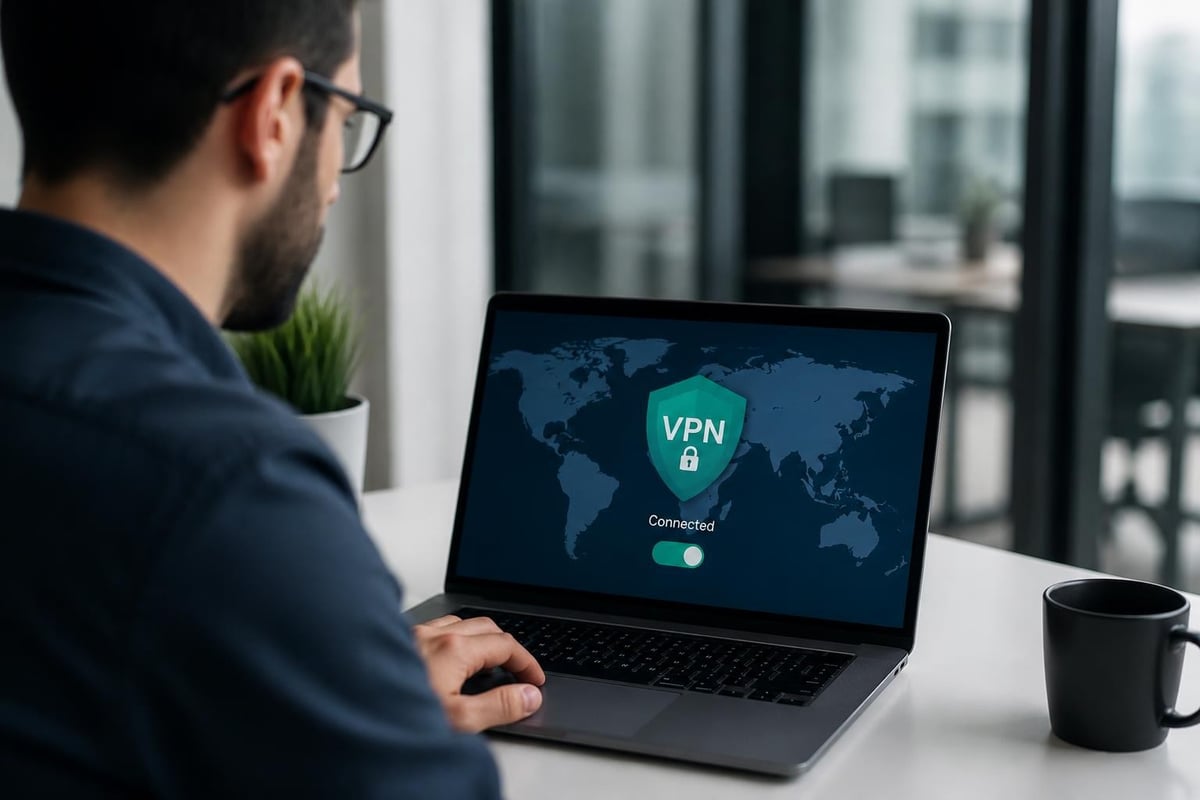
Your VPN client application initiates the connection process by authenticating your credentials and requesting access to the VPN server network. Modern VPN clients like those provided by ZioFree handle complex encryption processes automatically, requiring minimal user intervention.
Key client-side functions include:
- Authentication credential management
- Encryption key generation and exchange
- Protocol selection and configuration
- Network interface management
- DNS request handling
The client software also manages your connection preferences, including server selection, protocol choices, and kill switch activation. These settings determine how the VPN behaves under various network conditions.
Server Infrastructure and Global Networks
VPN servers form the backbone of the network, providing exit points for your encrypted traffic. When examining how VPN network work, the server infrastructure represents the physical manifestation of your new virtual location.
Server networks span multiple countries and regions, offering geographic diversity for bypassing restrictions and optimizing connection speeds. Premium providers maintain thousands of servers across dozens of countries, ensuring reliable performance and minimal congestion.
| Server Component | Function | Impact on Performance |
|---|---|---|
| Entry Node | Receives encrypted connection | Latency initiation point |
| Processing Core | Handles encryption/decryption | Processing speed affects throughput |
| Exit Node | Sends traffic to destination | Geographic location matters |
| Load Balancer | Distributes user connections | Prevents server overload |
Encryption Protocols and Security Mechanisms
The encryption layer is where VPN networks derive their security strength. Understanding how VPN network work requires knowledge of the cryptographic protocols that scramble your data into unreadable formats.
Modern Encryption Standards
Contemporary VPN services implement AES-256 encryption, a military-grade standard that would take billions of years to crack using current computing power. This symmetric encryption algorithm processes data in fixed-size blocks, applying multiple rounds of substitution and permutation.
The encryption process involves several steps:
- Key Generation: Creating unique encryption keys for each session
- Data Segmentation: Breaking information into manageable blocks
- Cipher Application: Applying the encryption algorithm to each block
- Authentication: Adding integrity verification to prevent tampering
- Transmission: Sending encrypted packets through the tunnel
Different VPN protocols handle encryption with varying approaches. OpenVPN uses SSL/TLS for key exchange, while WireGuard implements modern cryptographic primitives with a leaner codebase. Those exploring secure VPN options should prioritize services offering multiple protocol choices.
Tunneling Protocols Explained
Tunneling protocols define how VPN network work by establishing the rules for encapsulating and transmitting data. Each protocol offers distinct advantages regarding speed, security, and compatibility.
Popular VPN protocols in 2026:
- OpenVPN: Open-source, highly configurable, excellent security
- WireGuard: Modern, lightweight, superior performance
- IKEv2/IPsec: Fast reconnection, ideal for mobile devices
- L2TP/IPsec: Legacy support, moderate security
- Proprietary Protocols: Vendor-specific optimizations
The protocol selection impacts how effectively VPN network work for specific use cases. Gaming requires low latency protocols, while maximum security scenarios demand robust encryption regardless of speed penalties.
The Data Journey Through VPN Tunnels
When you send data through a VPN, your information follows a specific path that transforms and protects it at each stage. Visualizing how VPN network work through this data journey clarifies the protection mechanisms in action.
Packet Encapsulation Process
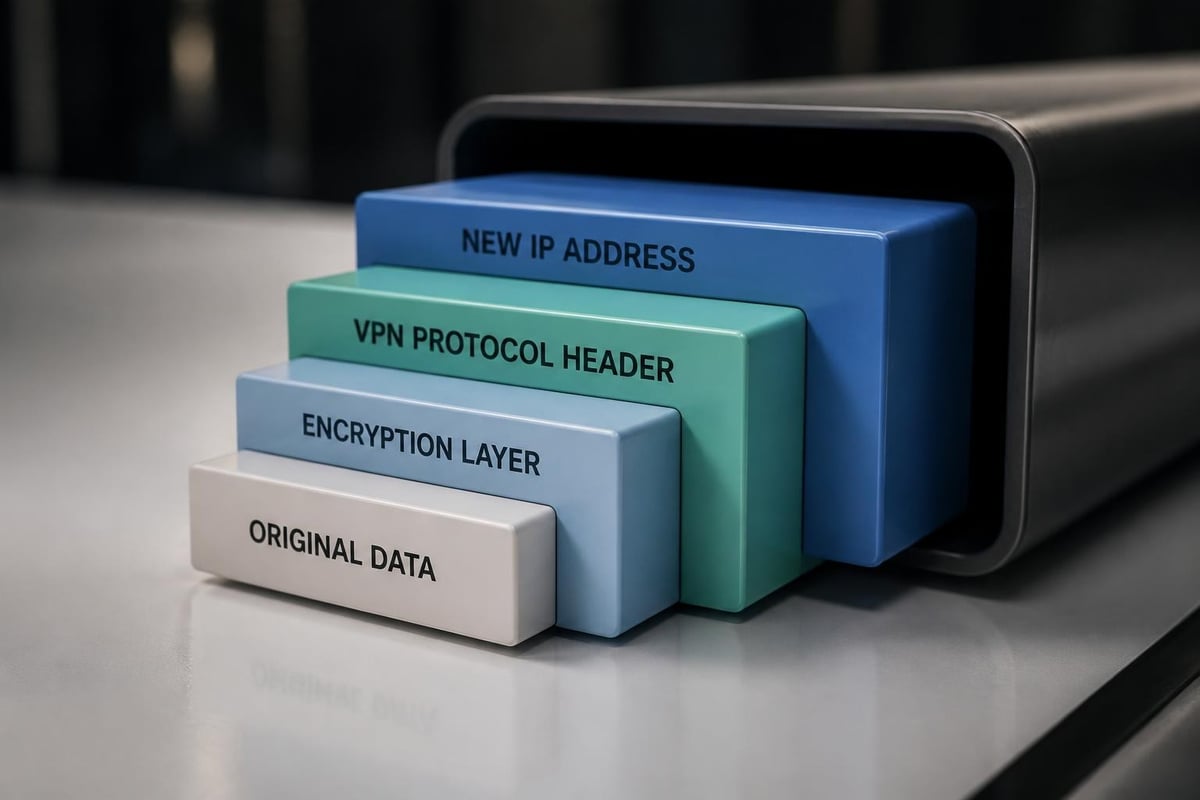
Your original data packet gets wrapped in multiple layers of encryption and routing information, similar to placing a letter in multiple sealed envelopes. The outer layers contain information necessary for routing through the VPN tunnel, while inner layers protect your actual data.
The encapsulation sequence proceeds as follows:
- Application generates data (web request, email, file transfer)
- VPN client intercepts the data before it reaches your ISP
- Client encrypts the payload using session keys
- Encrypted data gets wrapped in VPN protocol headers
- New IP header added with VPN server as destination
- Packet transmitted through standard internet infrastructure
- VPN server receives and strips outer layers
- Server decrypts inner payload and forwards to destination
Server-Side Processing and Exit
Upon reaching the VPN server, your encrypted packets undergo reverse processing. The server decrypts your data and forwards it to the intended destination using its own IP address, effectively masking your original location.
This server-side operation is critical to understanding how VPN network work for anonymity purposes. Websites and services see the VPN server's IP address instead of your actual address, preventing accurate geographic tracking or personal identification.
| Processing Stage | Server Action | Privacy Benefit |
|---|---|---|
| Packet Reception | Validates encrypted data | Prevents packet injection |
| Decryption | Unwraps payload layers | Accesses original request |
| IP Substitution | Replaces source IP | Hides user location |
| Traffic Forwarding | Routes to destination | Appears as server traffic |
| Response Collection | Receives destination reply | Centralizes return traffic |
| Re-encryption | Secures return data | Protects response privacy |
Authentication and Connection Establishment
Before any data transmission occurs, VPN networks must verify user identity and establish secure session parameters. This authentication phase determines who can access the network and under what security conditions.
User Authentication Methods
Modern VPN services employ multiple authentication layers to prevent unauthorized access. Username and password combinations form the first barrier, while additional factors like two-factor authentication codes or digital certificates provide enhanced security.
Common authentication mechanisms include:
- Credential-based login (username/password)
- Multi-factor authentication (2FA/MFA)
- Certificate-based authentication
- Pre-shared keys (PSK)
- Single sign-on (SSO) integration
Services implementing no-logs policies must balance authentication requirements with privacy commitments, storing minimal user information while maintaining security standards.
Handshake and Key Exchange
The handshake process establishes the cryptographic parameters for your VPN session. During this negotiation, your client and the server agree on encryption algorithms, exchange keys, and verify each other's identities.
Understanding how VPN network work during handshake reveals the complexity behind seemingly instantaneous connections. The process involves multiple message exchanges, certificate verification, and random number generation to create unique session keys that protect your specific connection.
DNS Resolution and Traffic Routing
Domain Name System (DNS) handling represents a critical aspect of how VPN network work for complete privacy protection. Without proper DNS management, your internet service provider could still monitor which websites you visit, even with an active VPN connection.
DNS Leak Prevention
VPN networks implement DNS leak protection by routing all DNS queries through the encrypted tunnel to DNS servers controlled by the VPN provider. This prevents your ISP's DNS servers from logging your browsing activity and ensures consistent privacy coverage.
Standard DNS resolution follows this modified path:
- Browser requests website address
- VPN client intercepts DNS query
- Query encrypted and sent through tunnel
- VPN server's DNS resolver handles lookup
- Response encrypted and returned through tunnel
- Client decrypts and provides address to browser
Services prioritizing privacy protection implement their own DNS infrastructure rather than relying on third-party resolvers that might log queries.
Split Tunneling Capabilities
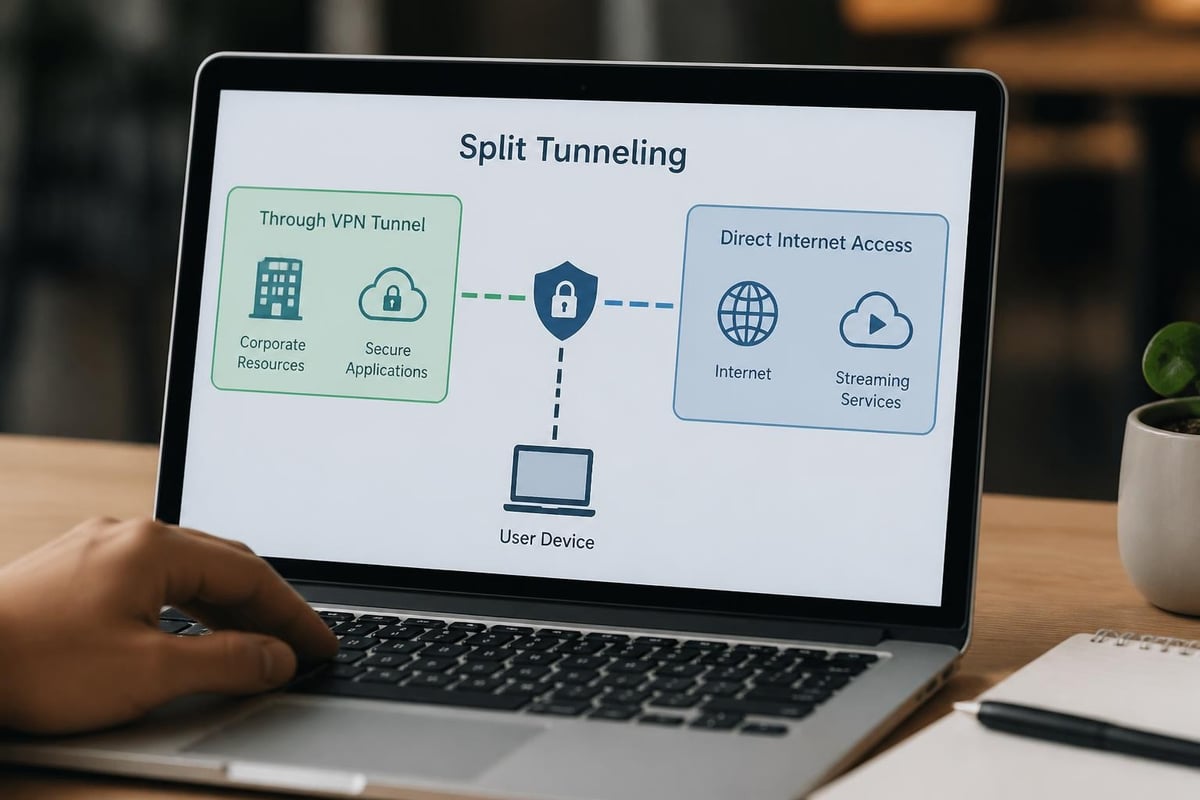
Advanced VPN configurations allow split tunneling, where you designate which applications or destinations use the VPN tunnel while others connect directly to the internet. This feature demonstrates sophisticated control over how VPN network work for different traffic types.
Split tunneling offers flexibility for scenarios requiring both security and performance. You might route banking transactions through the VPN while allowing local network printers to connect directly, or encrypt international communications while keeping domestic traffic on standard paths.
Network Address Translation and Port Management
Network Address Translation (NAT) plays an essential role in how VPN network work for multiple simultaneous users. VPN servers must manage thousands of concurrent connections, each requiring unique identification for proper data routing.
NAT Implementation in VPNs
VPN servers use NAT to map internal tunnel addresses to external internet addresses. When your encrypted packet exits the VPN server, NAT translates your assigned virtual IP to the server's public IP while maintaining connection state information for return traffic.
This process enables multiple VPN users to share a single public IP address without traffic collision. The server tracks each user's session through port numbers and internal identifiers, ensuring responses reach the correct client.
NAT benefits for VPN operations:
- Efficient IP address utilization
- Additional privacy layer through IP sharing
- Simplified server infrastructure management
- Reduced IPv4 address requirements
- Enhanced anonymity through user mixing
Performance Optimization and Server Selection
Connection speed and reliability depend significantly on how VPN network work regarding server selection and traffic optimization. Geographic proximity, server load, and routing efficiency all impact your experience.
Intelligent Server Connection
Modern VPN clients analyze multiple factors when connecting to servers. Distance affects latency, but an overcrowded nearby server might perform worse than a distant server with ample capacity. Advanced algorithms consider current load, historical performance, and network conditions.
When evaluating VPN bandwidth performance, users should test multiple servers at different times to identify optimal connections for their specific location and internet service provider.
| Selection Factor | Impact on Speed | Impact on Privacy |
|---|---|---|
| Geographic Distance | High latency increase with distance | Minimal effect |
| Server Load | Significant speed reduction when overloaded | No direct impact |
| Routing Path | ISP peering affects throughput | Path diversity matters |
| Protocol Choice | Speed varies by protocol overhead | Security level differs |
| Encryption Strength | Stronger encryption requires more processing | Higher protection level |
Connection Stability Mechanisms
Maintaining stable VPN connections requires handling network transitions and temporary disruptions gracefully. Kill switch technology represents a critical stability feature, immediately blocking all internet traffic if the VPN connection drops unexpectedly.
Automatic reconnection protocols monitor connection health and re-establish tunnels when interruptions occur. This seamless recovery ensures continuous protection without requiring manual intervention, particularly important for mobile users frequently switching between WiFi and cellular networks.
Protocol Port Usage and Firewall Traversal
Understanding how VPN network work in restrictive environments requires knowledge of port usage and firewall circumvention techniques. Many networks block standard VPN ports to prevent encrypted traffic, necessitating sophisticated workarounds.
Standard Port Configurations
Different VPN protocols operate on specific ports by default. OpenVPN typically uses port 1194 for UDP connections and port 443 for TCP, while WireGuard defaults to port 51820. Using port 443 helps VPN traffic masquerade as standard HTTPS web traffic, improving firewall compatibility.
Network administrators implementing restrictive policies often block known VPN ports. Advanced VPN services offer multiple protocol options with port flexibility, allowing users to find working configurations even in challenging network environments.
Common VPN port assignments:
- OpenVPN: 1194 (UDP), 443 (TCP)
- WireGuard: 51820 (UDP)
- IKEv2: 500 (UDP), 4500 (UDP)
- L2TP: 1701 (UDP), with IPsec on 500/4500
- SSTP: 443 (TCP)
Obfuscation Techniques
When standard VPN protocols face blocking, obfuscation technologies disguise VPN traffic as regular internet activity. These techniques modify packet headers and timing patterns to evade deep packet inspection systems that identify VPN signatures.
Obfuscation becomes essential for users in countries with aggressive internet censorship. By understanding how VPN network work with obfuscation enabled, users can maintain secure connections even when governments actively attempt to block VPN usage.
Integration With Home and Corporate Networks
VPN technology extends beyond individual privacy to enable secure remote access to private networks. Understanding how VPN network work in these contexts reveals additional use cases beyond simple privacy protection.
Site-to-Site VPN Configurations
Businesses connect entire offices through site-to-site VPNs, creating virtual LANs spanning multiple geographic locations. These permanent VPN tunnels allow seamless resource sharing as if remote offices occupied the same physical network.
The configuration requires VPN-capable routers at each location, establishing always-on encrypted tunnels between sites. Employees access network resources transparently without individual VPN client software, as their traffic automatically routes through the site-to-site tunnel.
Those interested in securing home networks with VPN technology can implement similar approaches, protecting all household devices through router-level VPN connections rather than configuring each device individually.
Remote Access VPN Implementation
Remote access VPNs enable individual users to connect to private networks from any location. Employees working from home, travelers accessing company resources, and mobile workers all rely on remote access VPN architecture.
This implementation requires VPN concentrators or dedicated servers accepting incoming connections, authenticating users, and granting appropriate network access based on permissions. The same underlying technology that explains how VPN network work for privacy also secures corporate resources from unauthorized access.
Future Developments in VPN Technology
VPN networks continue evolving to address emerging threats and leverage new technologies. The fundamental principles of how VPN network work remain consistent, but implementations advance to meet changing security landscapes and performance expectations.
Quantum-Resistant Encryption
Post-quantum cryptography development addresses future threats from quantum computers capable of breaking current encryption standards. Leading VPN providers are testing quantum-resistant algorithms to ensure long-term security as quantum computing becomes practical.
This proactive approach ensures that data encrypted today remains secure even when quantum computers mature. Understanding how VPN network work with these advanced cryptographic systems prepares users for the next generation of privacy technology.
Protocol Evolution and Optimization
New protocols like WireGuard demonstrate the ongoing refinement of VPN technology, achieving faster speeds with smaller codebases than legacy protocols. This trend toward efficiency without sacrificing security shapes the future of VPN networks.
The balance between speed and security continues improving as protocols mature and hardware acceleration becomes standard. Users comparing fast VPN services benefit from these protocol advances, experiencing minimal speed penalties while maintaining robust encryption.
Understanding the technical details of how VPN network work empowers users to make informed decisions about their online privacy and security. From encryption protocols and tunneling mechanisms to server infrastructure and authentication systems, each component contributes to creating secure, private internet connections that protect your digital activities from surveillance and interference. ZioFree delivers these sophisticated technologies through user-friendly applications backed by advanced security protocols, a strict no-logs policy, and a global server network designed to protect your privacy without compromise.